
• Skip to main content
  • Skip to primary sidebar
  • Skip to footer
Peak Performance Fitness

Lynbrook | New Hyde Park | NY

  • Home
  • Why Peak Fitness
    • About Us
    • Meet Our Team
    • Our Facilities
    • Testimonials
  • Our Programs
    • Weight Loss Program
    • Personal Training
    • Sports Specific Training
    • VO2 / RMR Analysis
    • InBody Body Composition Analysis
    • ACL Rehabilitation
    • Classes / TRX Training
    • Insurance Reimbursement
  • Free Trial
  • Contact
  • Blog
  • Gift Certificates
  • Physical Therapy Center
  • Home
  • Why Peak Fitness
    • About Us
    • Meet Our Team
    • Our Facilities
    • Testimonials
  • Our Programs
    • Weight Loss Program
    • Personal Training
    • Sports Specific Training
    • VO2 / RMR Analysis
    • InBody Body Composition Analysis
    • ACL Rehabilitation
    • Classes / TRX Training
    • Insurance Reimbursement
  • Free Trial
  • Contact
  • Blog
  • Gift Certificates
  • Physical Therapy Center

running

Taking Your Workouts Outside

April 18, 2017

Sick of exercising in doors? Well I have some good news for you, Spring has finally arrived! This means we can say goodbye to those days consisting of below-freezing temperatures and hello to some fun in the sun. There is a great week of weather ahead- are you itching it get outside to workout? And not just because of allergies… 

Although you may not realize, many activities we do outdoors can actually have a high caloric expenditure, possibly just as much as 30 minutes on your favorite inside cardio equipment.  Exercising outdoors is a great way to break the monotony, have some fun, and get a great workout.  Below is a list of many different ideas for some physical activity in the sun:

  • Going for a bike ride
  • Taking a jog
  • Brisk walking
  • Walking your dog
  • Rollerblading
  • Beach Volleyball – an hour can burn up to 200 calories
  • Tennis – 30 minutes can burn up to 200 calories
  • Golf (carrying clubs and walking to each hole) – an hour can burn anywhere from 300-500 calories
  • Pick-up Basketball game – up to 500 calories an hour

Try to get the whole family involved so you don’t have to exercise alone!  Not only will the family help motivate you to consistently stay active, but this is an ideal bonding experience and a great escape from our phones and other electronic devices.

If you’re searching for somewhere to bring the family on a weekend afternoon, some great places local to Peak Performance include the Long Beach Boardwalk and Hendrickson Park in Valley Stream!


By Anthony Locast
Filed Under: News Tagged With: Diet, Exercise, Fitness, goals, health, healthy, members, motivation, physiologists, running, Sports, strength training, stretching, success, summer, weight loss, Workout

Muscle Madness: Quadriceps

April 3, 2017

The Exercise Physiologists at Peak Performance know all the muscles in the body, but which ones are our favorite?! Every week we will feature a different muscle- so you guys get an anatomy lesson and learn how to work that muscle!

David, what’s your favorite muscle?

The Quadriceps are actually a group of 4 muscles (vastus medialis, vastus lateralis, vastus intermedius, and rectus femoris) also known as the “quads.” The quads are my favorite because they play a huge role in athletic performance.

Where are these muscles located?

The quadriceps are located on the front of your upper leg. They begin near your hips down and run down to just below your knee.

What does this muscle do?

The quads main function is to extend (straighten) the lower leg. For example, when kicking a soccer ball, standing up from a squat, or jumping.

What’s a good exercise to strengthen the quadriceps?

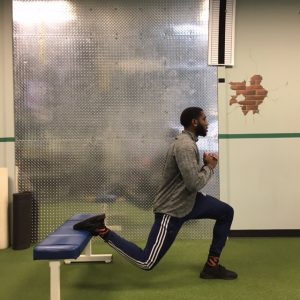
Single leg exercises for the quads are straight leg raises, lunges, and split squats. Squats, leg press, and vertical jumps are great double leg exercises for the quads.

Filed Under: News Tagged With: Exercise, Fitness, goals, health, healthy, members, motivation, physiologists, running, Sports, sports performance, strength training, stretching, success, tips, weight loss, Workout

Off-Season Weight Training for Athletes

March 21, 2017

Resistance training is a major component for progression in athletic performance. Although the best way to improve performance would be to practice the skills specific to that sport, resistance training allows athletes to target certain muscles/muscles groups. Strength training off the playing field will help them become stronger for their sport.

Off-season resistance training is a great way to get ahead of the competition without interfering with in-season practice schedules. In addition, due to its length, the off-season allows for longer periods of training for progressing specific resistance exercises. A traditional offseason resistance training program for the majority of athletes should be split in to 3 phases; Hypertrophy, Strength, and Power.

Hypertrophy Phase
Hypertrophy means muscle growth (increases in size of muscle fibers). Increased muscle size translates to muscles that are more efficiently capable of becoming stronger muscles. This type of training is characterized by high volume workouts; high sets and repetitions, low to moderate weights, and smaller rest times.

Strength Phase
Strength is the ability to move the most possible weight. Utilizing the increased muscle size from the hypertrophy phase, athletes should be safely attempting heavy lifts in order to increase overall strength. The strength phase is characterized by lower repetitions, increased weights and rest times.

Power Phase
Power is defined as ones ability to perform an exercise over a specific unit of time. Power exercises are characterized as explosive, sport-specific movements that involve strength and speed (Olympic lifts, box jumps, sled push/pulls etc.) Utilizing strength gains from the previous phase, athletes should be able to move heavier weights more quickly and explosively. Workouts should be sport specific and focus on the speed and efficiency of heavy lifting. The power phase is characterized by lower repetitions, moderate to heavy weights, and moderate rest times.

Following the final phase of the off-season, athletes should decrease their time in the weight room in order to recover and make time for pre-season practice in their respective sports. A well planned training program can keep an athlete in shape during the long off-season and give them the boost they need to be a step ahead of the competition!


By David McCalla

Filed Under: News Tagged With: Exercise, Fitness, goals, health, healthy, members, motivation, physiologists, running, Spine, Sports, sports performance, sprinting, strength training, stretching, success, tips, warmup, weight loss, Workout

Warming Up for Recreational Sports

March 15, 2017

March Madness is here and spring is right around the corner! Baseball has started Spring Training and the weather is starting to get nicer as the days get longer. For all of the avid basketball fans and recreational players, it’s exciting to watch the college basketball season come to a close. Many of us don’t do as much physical activities in the winter as we do when the weather starts to get warmer. We all can reminisce on the “good old days” when we were able to just go for a run or play a sport without warming up. However, the more time you’ve spent away from an activity should mean more time that you spend on a quality warm up and cool down. This is important to help prevent injuries and ensure you’re feeling great for the next days.

Taking 5-10 minutes to go through some light stretching and dynamic movements is important for your well-being. Here’s an example of a simple warm up you can do before most physical activities:

1) Light Jogging ~3-5 minutes

2) Walking Quad stretch (kick your heels up to your butt while stepping forward)

3) Frankenstein’s (lightly kicking leg straight in front while walking forward)

4) Lunge with Reach (step forward with one leg then bend both knees to 90 degrees and lift arms to the sky)

5) Side Lunges (with toes facing forward, step sideways bending one leg while keeping the other straight then step to the other side)

There are many different warm ups and ways to make it more for your activity. Your Exercise Physiologist can develop a specific program for you. Remember the goal of a warm up is to get your body ready for the activities it will soon be doing. Increasing your heart rate and increasing blood flow to skeletal muscles will decrease your chance for injuries during sports. Most importantly, have fun out there and be safe!


Corynne Pereira

Filed Under: News Tagged With: Exercise, Fitness, goals, health, healthy, members, motivation, physiologists, running, Sports, sports performance, sprinting, strength training, stretching, success, Workout

Sports Spotlight: Improving Your Sprint Performance

July 12, 2016

Here is the second part of our Summer Sports Spotlight! This is a three part series on how to increase your sprinting mechanics and get faster.

Improve your sprinting technique

Without ever lifting a weight, it is possible to get faster just be learning to be more efficient! Here are some common aspects of running that get overlooked, along with some techniques to improve them!

  • Strike the ground at the mid foot. By making a heel-to-toe contact as you run you aren’t optimally utilizing your ground striking mechanics!
  • Keep your shoulders relaxed and avoid from shrugging
  • Keep a symmetrical rhythm between your arms and legs and be sure your arms aren’t crossing over your body.

Increase your overall strength

  • The stronger you are, the more force you’ll be able to produce into the ground. This force will be generated from your type two muscle fibers rather than your type one fibers and understanding the differences between these two fibers is the key to ensure you’re training properly.
  • Type one muscle fibers are used to maintain exercise and activity for a long duration of time, which means their ability to generate short term maximal power is limited while type two fibers are explosive and meant to generate a high amount of power for a single rep or a short duration.
  • The best way to grow these type two fibers are to make sure they’re being trained against resistance. Look at the picture to the right and ask yourself, “Which of these two athletes lift in their program?” The answer should be obvious. By using weights at a high enough resistance to build strength (thus leading to increased type II fiber size) he is placing his muscles under the similar demands of generating maximal force into the ground.
  • Although it may seem counter-intuitive to hit the weight room instead of the track to get better at running, you need to have a balance of both. Adding in weight training to your running program could be the key to breaking out of your plateau!


Improve your triple extension

  • Triple extension is the simultaneous extension of your ankles, knees, and hips.
  • Improving your explosiveness through this position will let you move faster by improving your stride frequency, this is the amount of times you complete a full stride cycle during your run. The main difference between sub-elite and elite athletes is stride frequency, meaning it’s more beneficial to take frequent steps rather than taking just longer steps.
  • Olympic lifts are exercises that are specific to improving triple extension and are designed to improve explosiveness. These exercises involve total body movement performed as quickly as possible. Note that in frame one and two of the picture (featured left) the athlete has performed a hang clean by moving into triple extension to drive to bar off the floor.


Talk to one of our certified strength and conditioning specialists if you feel incorporating Olympic lifts and improving triple extension would take your game to the next level.


By Dave Albaranes

Filed Under: News Tagged With: running, Sports, sprinting, strength training, warmup

Sports Spotlight: Warm Up Drills for Sprinting

June 21, 2016

With the summer upon us, many athletes are taking the advantage of the weather to train outside. For athletes working on improving their linear speed, this is the best time of the year to get out on the track. This is a three part series on how to increase your sprinting mechanics and get faster!

We’ll start with technique! Before you even work on your explosiveness or lift a weight, lets ensure you’re correctly doing everything you can to get the most out of your mechanics. Here are 3 warm-up drills to help improve efficiency in your speed workouts.

Warm-up Drills

A-skips


  • A-skips are high knee kicks with reciprocal arm movement.
  • They get your hip flexors warmed up so they will be prepared to fire fast when you need them too.
  • It helps teach how to coordinate raising the opposite arm to your lead leg.
  • Moving through this position quickly will help improve your explosiveness. (More on this in my next article on triple extension)


B-skips

  • B skips are A-skips followed with a full knee extension out.
  • B skips emphasize keeping the foot strike in the proper position.
  • Accelerating your feet to the ground helps ensure you can translate the drill into your actual sprint.


Wall Sprints

  • By keeping yourself at a 45 degree angle (what’s called your power line) against the wall, you put yourself in the best position for acceleration.
  • By holding power line and working different marching techniques you can train your sprinting mechanics without going anywhere!
  • Be sure to keep your hip drive high, your shin at a 45 degree angle, and your toes up!


Check in with Peak’s strength and conditioning specialists to learn these warm-up drills and have your sprinting form critiqued! Throwing these in your warm-up will help you fire your running specific muscles and keep you injury free by improving your technique. To help you further cut your sprint times down, check out my next upcoming article on improving your explosiveness by increasing your triple extension!


By Dave Albaranes

Filed Under: News Tagged With: running, Sports, sprinting, warmup

  • « Go to Previous Page
  • Page 1
  • Interim pages omitted …
  • Page 7
  • Page 8
  • Page 9

Primary Sidebar

Recent Posts

  • RECIPE OF THE WEEK: HIGH-PROTEIN PEANUT BUTTER BANANA OVERNIGHT OATS
  • RECIPE OF THE WEEK: HIGH-PROTEIN M&M CHRISTMAS COOKIES
  • RECIPE OF THE WEEK: BUFFALO SHRIMP LETTUCE WRAPS
  • RECIPE OF THE WEEK: CROCKPOT CREAMY CASHEW CHICKEN
  • RECIPE OF THE WEEK: HERB-ROASTED TURKEY

Categories

  • News
  • Recipes

Get Started: (516) 548-7443 | fitness@peakptfitness.com

Footer

Peak Performance Fitness

  • Home
  • Why Peak Fitness
  • Programs
  • Free Trial
  • Contact
  • Blog
  • Gift Certificates
  • Physical Therapy Center

Our Programs

  • Weight Loss Program
  • Personal Training
  • Sports Specific Training
  • VO2 / RMR Analysis
  • Classes / TRX Training
  • ACL Rehabilitation Program
  • Insurance Reimbursement

225 Merrick Road
Lynbrook, NY 11563
USA

T +1 (516) 548-7443
T +1 (516) 599-8734
F +1 (516) 887-0803
E fitness@peakptfitness.com

Mailing List Signup

Join our mailing list to stay up to date on the latest news, events and exclusive offers!

Join Us Online

  • Facebook
  • Instagram
  • Twitter

Peak Performance Fitness | Visit the Peak Physical Therapy Center
Lynbrook: 225 Merrick Road, Lynbrook, NY 11563
Copyright © 2026 Peak Performance Fitness